

London | Special Report
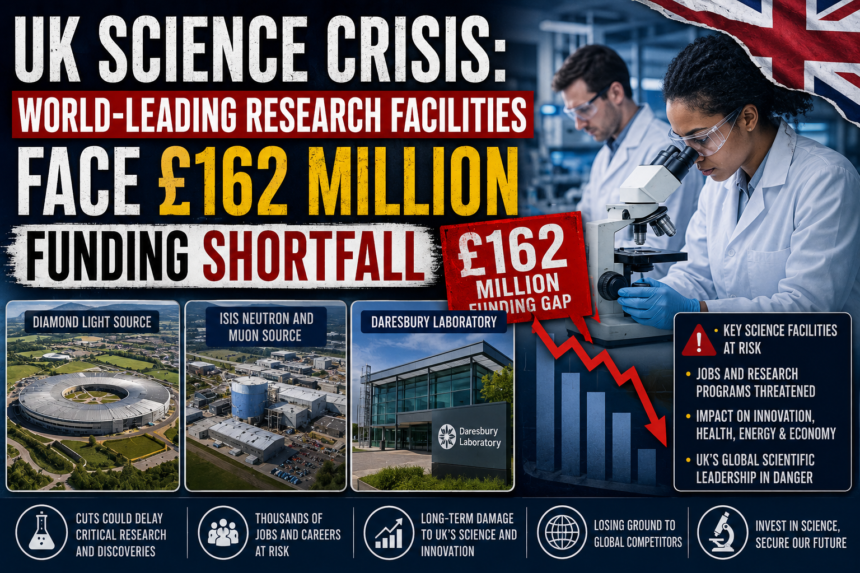
The United Kingdom’s reputation as a global scientific powerhouse is facing a major challenge after reports revealed that several of the country’s most important research facilities could face significant budget cuts or even partial closure due to a £162 million funding shortfall. The crisis centers on the Science and Technology Facilities Council (STFC), the government agency responsible for operating and funding many of Britain’s world-leading scientific laboratories and research infrastructure.
Scientists, researchers, and industry leaders have warned that the proposed reductions could have long-term consequences for innovation, economic growth, and the UK’s international scientific standing. Facilities that support thousands of researchers and hundreds of companies each year are now being asked to identify substantial cost savings.
What Is the Funding Crisis?

According to reports, the STFC is attempting to save at least £162 million by 2029–30 after facing rising operational expenses. Increased electricity prices, higher staffing costs, inflation, and the growing cost of participating in international scientific collaborations have placed severe pressure on budgets.
As a result, managers at major research facilities have been instructed to examine spending reductions ranging from 10% to 20%. Some projects across physics, astronomy, and related disciplines may also face funding cuts or delays.
Researchers argue that while cost pressures are real, reducing support for critical scientific infrastructure could undermine decades of investment and damage Britain’s research ecosystem.
Facilities Under Threat
Among the facilities most frequently mentioned in discussions are:
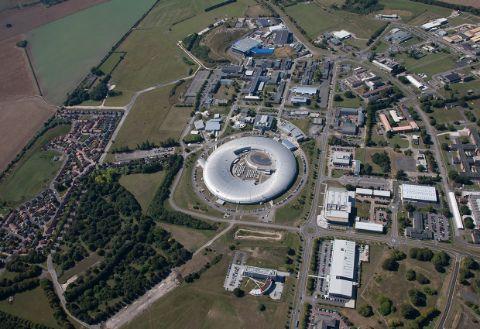
Diamond Light Source
Located in Oxfordshire, the Diamond Light Source is the UK’s national synchrotron facility. It generates extremely bright beams of light that allow scientists to study materials, medicines, viruses, batteries, and advanced technologies at the atomic level. The facility is used by researchers from universities, hospitals, and private companies worldwide.
A major upgrade project known as Diamond-II is considered crucial for maintaining the UK’s competitiveness in advanced scientific research. Experts fear that funding uncertainty could delay or weaken the project.
ISIS Neutron and Muon Source
Also located in Oxfordshire, the ISIS facility is one of the world’s leading neutron research centers. Scientists use it to investigate materials for clean energy, healthcare, engineering, and manufacturing. The facility already faces operational pressures and staffing challenges, making further budget reductions particularly concerning.
Daresbury Laboratory
Situated in Cheshire, Daresbury Laboratory supports research in accelerator science, computing, engineering, and advanced technologies. It plays an important role in connecting academic research with industrial innovation. Budget reductions could affect both scientific projects and technology development programs.
Why These Facilities Matter
These laboratories are not simply academic institutions. They form the backbone of Britain’s scientific infrastructure and support research with practical applications across many sectors.
Their work contributes to:
- Medical research and drug development
- Clean energy technologies
- Artificial intelligence and computing
- Aerospace and defense innovation
- Advanced manufacturing
- Materials science and engineering
Many discoveries that eventually become commercial products begin with research conducted at facilities like Diamond and ISIS. Scientists warn that weakening these institutions could reduce future innovation and economic growth.
Growing Concern Within the Scientific Community

The funding crisis has triggered strong reactions from leading figures in British science.
The Institute of Physics and numerous university departments have expressed concern that rapid funding reductions could cause lasting damage to the UK’s scientific capabilities. Researchers argue that scientific infrastructure cannot easily be rebuilt once expertise, equipment, and talent are lost.
Professor Brian Cox has previously criticized similar reductions, describing cuts to fundamental physics research as harmful to the nation’s future scientific prospects.
Many experts also fear that uncertainty will encourage talented researchers to move abroad in search of more stable funding opportunities.
Impact on Young Scientists
One of the biggest concerns is the effect on early-career researchers.
Postdoctoral scientists, graduate students, and young academics often depend on grants and facility access to build their careers. Funding reductions could mean:
- Fewer research positions
- Reduced grant opportunities
- Delayed scientific projects
- Loss of international collaborations
Several scientific organizations have warned that Britain risks losing an entire generation of researchers if long-term funding uncertainty continues.
International Competitiveness at Stake
The United Kingdom has long been regarded as a leader in fields such as particle physics, astronomy, space science, and materials research.
British scientists play major roles in international projects, including:
- CERN particle physics experiments
- Space research programs
- Global astronomy initiatives
- Advanced computing collaborations
Funding reductions may weaken Britain’s ability to participate in these projects and maintain leadership in emerging technologies.
Some experts worry that other countries could gain an advantage if the UK reduces investment in fundamental science while competitors continue expanding research spending.
Government and STFC Response

STFC officials have acknowledged the financial pressures and stated that difficult decisions may be necessary to balance budgets. However, they emphasize that no final decisions have yet been made regarding closures or specific reductions. Reviews are currently underway, and outcomes are expected later in the year.
The organization maintains that it remains committed to supporting world-class research while adapting to financial realities.
Conclusion
The £162 million funding crisis facing the UK’s Science and Technology Facilities Council has sparked widespread concern across the scientific community. World-renowned facilities such as the Diamond Light Source, ISIS Neutron and Muon Source, and Daresbury Laboratory now face an uncertain future as officials search for ways to reduce spending. While no final decisions have been made, scientists warn that short-term budget cuts could have consequences lasting decades, potentially weakening Britain’s position as a global leader in research, innovation, and technological discovery.