

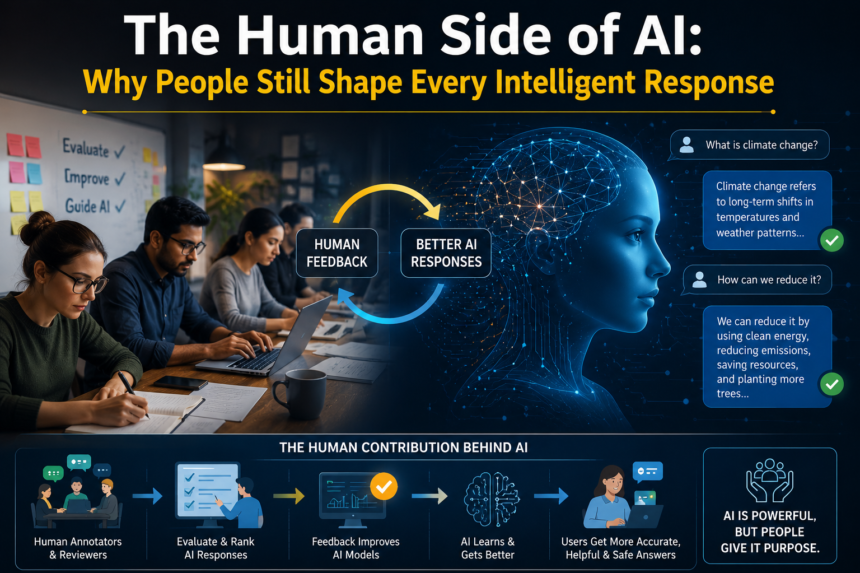
When people use AI tools such as ChatGPT, Gemini, Claude, or other advanced assistants, the interaction often feels almost magical. A question is typed, and within seconds, a detailed answer appears. To many users, it may seem as though the AI independently understands the world and generates intelligent responses on its own.
However, behind nearly every AI answer lies an invisible workforce of researchers, engineers, trainers, reviewers, and human evaluators. These people play a critical role in teaching AI systems how to communicate, reason, follow instructions, and behave safely. In fact, many experts argue that modern artificial intelligence is not just a product of algorithms and computing power—it is also a product of human judgment and feedback.
As AI becomes increasingly powerful and integrated into daily life, the importance of human feedback is becoming more evident than ever.
AI Does Not Learn Like Humans
Many people assume that AI learns exactly the way humans do. In reality, modern AI systems begin by analyzing enormous amounts of text from books, websites, research papers, and other public sources.
This initial training allows AI models to recognize patterns in language and predict the next word in a sentence. While this process helps AI generate fluent text, it does not automatically teach the system what humans consider helpful, accurate, ethical, or safe.
Without additional guidance, AI can:
- Produce incorrect information
- Misinterpret user intentions
- Generate biased responses
- Give unsafe advice
- Create misleading content
This is where human feedback becomes essential.
The Rise of Human Feedback in AI Development
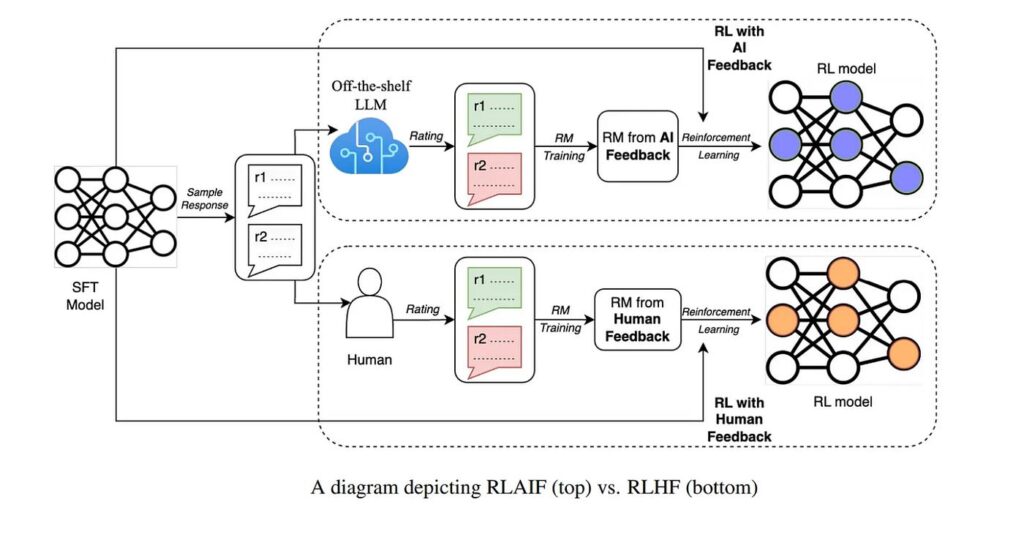
Over the last few years, AI companies have increasingly relied on a process known as Reinforcement Learning from Human Feedback (RLHF).
RLHF allows humans to evaluate AI-generated responses and indicate which answers are better, safer, clearer, or more useful. Those human preferences are then used to train AI systems to behave in ways people find helpful.
The process generally works in three stages:
Step 1: AI Generates Multiple Answers
The AI produces several possible responses to a question.
Step 2: Human Review the Answers
Human reviewers compare the responses and rank them based on factors such as:
- Accuracy
- Clarity
- Helpfulness
- Safety
- Reasoning quality
Step 3: AI Learns Human Preferences
The rankings are used to create reward models that guide future training. Over time, the AI learns which types of responses humans prefer and adjusts its behavior accordingly.
This human-centered approach has become one of the most important innovations in modern AI development.
Why Human Feedback Matters
AI systems are incredibly good at detecting patterns, but they do not naturally understand human values.
For example, a technically correct answer may still be confusing, insensitive, or unhelpful. Human reviewers help teach AI what makes an answer truly valuable.
AMD CEO Lisa Su recently highlighted this limitation when she noted that AI may solve problems, but humans still decide which problems are worth solving in the first place. Human judgment remains irreplaceable in determining priorities, ethics, and real-world goals.
This human involvement helps AI:
- Communicate more naturally
- Reduce harmful outputs
- Follow instructions more accurately.
- Improve conversational consistency.
- Better align with user expectations.
The Invisible Workforce Behind AI
The success of modern AI depends on thousands of people whose contributions are rarely visible to users.
These individuals include:
Data Annotators
They label data and help AI understand relationships between words, images, and concepts.
AI Trainers
They create examples showing how AI should respond in various situations.
Quality Reviewers
They evaluate responses and identify mistakes.
Safety Researchers
They test models for harmful behaviors and vulnerabilities.
Subject Matter Experts
Lawyers, doctors, scientists, and educators often contribute specialized knowledge that helps improve AI performance in professional domains.
Together, these workers provide the human intelligence that guides artificial intelligence.
Human Values and AI Alignment
One of the biggest challenges facing AI developers is ensuring that AI systems remain aligned with human values.
This field, known as AI alignment, focuses on making sure AI behaves in ways that are beneficial, safe, and consistent with human goals.
Human feedback plays a central role in this effort.
Researchers use feedback to teach AI:
- What constitutes harmful content
- How to avoid misinformation
- How to handle sensitive topics
- How to balance competing priorities
Without human oversight, AI could optimize for the wrong objectives and produce unintended consequences.
Humans and AI Are Shaping Each Other
Interestingly, the relationship between humans and AI is not one-sided.
Researchers increasingly describe modern technology as a process of Human-AI Coevolution, where humans influence AI and AI influences human behaviour in return.
Every time users interact with AI:
- They generate new data.
- They provide signals about preferred responses.
- They influence future improvements.
At the same time, AI systems influence how people:
- Learn information
- Make decisions
- Consume content
- Communicate online
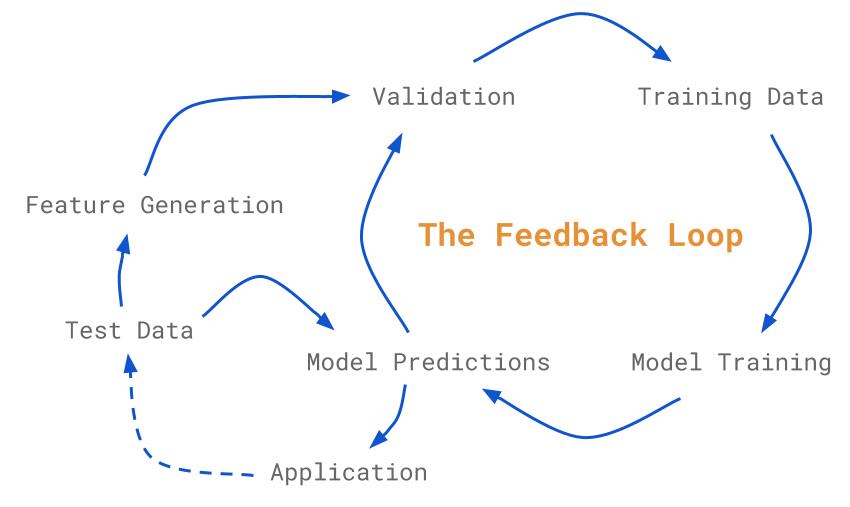
This creates a continuous feedback loop between people and machines.
The Challenge of Scaling Human Oversight
As AI systems become more capable, maintaining effective human supervision becomes increasingly difficult.
Researchers refer to this problem as scalable oversight.
The challenge is simple:
If AI becomes better than humans at certain tasks, how can humans reliably evaluate whether the AI is correct?
For example:
- Can humans verify highly complex scientific analyses?
- Can they detect subtle programming errors?
- Can they evaluate long-term policy recommendations?
As AI capabilities grow, new methods of oversight will be required to ensure human control remains effective.
Human Biases Also Shape AI
Human feedback improves AI, but it also introduces challenges.
Humans themselves have biases, preferences, and inconsistencies.
When people evaluate AI responses, their judgments may reflect:
- Cultural differences
- Political viewpoints
- Personal preferences
- Social norms
As a result, AI systems can inherit some of these biases. Research shows that AI may develop systematic patterns of judgment that differ from human reasoning and sometimes reflect unintended biases.
This is why AI companies continuously refine evaluation processes and seek diverse perspectives from reviewers.
AI Is Powerful, But Not Independent
Recent advances have led some AI systems to perform impressively on benchmarks and even pass certain versions of the Turing Test.
Yet experts emphasize that these achievements should not be confused with true independence.
AI remains dependent on:
- Human-created data
- Human-designed objectives
- Human feedback systems
- Human oversight mechanisms
Even the most advanced models today are deeply shaped by countless human decisions made throughout the training process.
The Future of Human-Centered AI
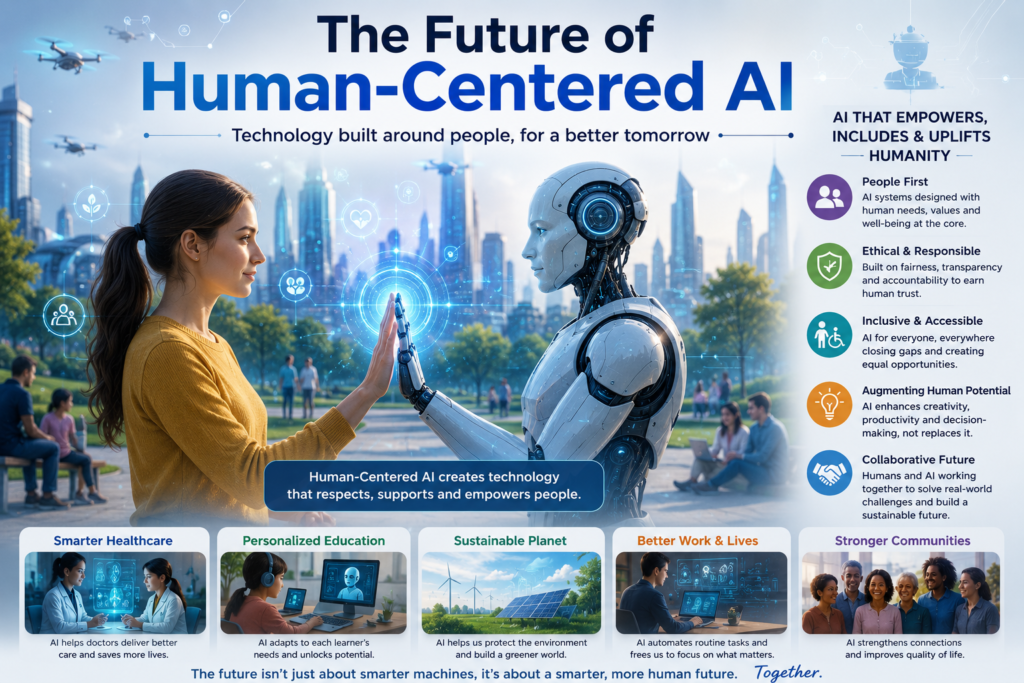
As AI becomes more integrated into healthcare, education, business, and government, the demand for human-centered AI will continue to grow.
Future AI systems are expected to place greater emphasis on:
- Transparency
- Accountability
- Fairness
- User control
- Ethical decision-making
Many experts believe that the most successful AI systems will not replace humans but work alongside them as collaborative tools.
The goal is not to create machines that act independently of people, but systems that amplify human creativity, productivity, and problem-solving abilities.
Conclusion
The rapid growth of artificial intelligence often creates the impression that machines are becoming fully autonomous. Yet the reality is far more human. Behind every AI-generated answer are thousands of decisions made by researchers, trainers, reviewers, and users who continuously shape how these systems behave.
From reinforcement learning and safety testing to ethical oversight and quality evaluation, human feedback remains the foundation of modern AI. As artificial intelligence continues to evolve, one truth remains clear: AI may provide the answers, but humans still play the most important role in determining what those answers should be.