
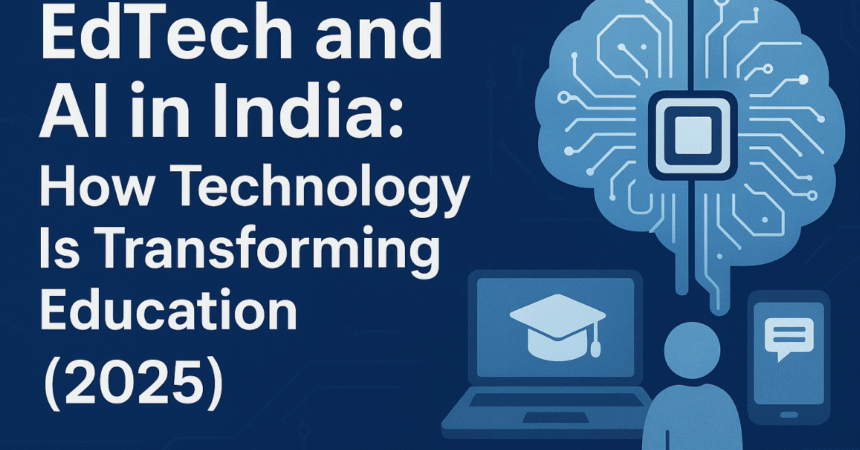
The Indian education system is undergoing one of its biggest transformations in decades — thanks to the rapid rise of Artificial Intelligence (AI) and Educational Technology (EdTech). From virtual classrooms to AI-powered personalized learning tools, the digital wave is redefining how students learn, teachers teach, and institutions operate.
🌐 The Shift Towards Smart Learning
In 2025, over 50% of higher education institutions in India are now using AI-based tools to design study materials, automate assessments, and track student progress, according to a Navbharat Times report.EdTech and AI in India
Platforms such as Byju’s, Unacademy, and Physics Wallah have integrated machine learning models that analyze student behavior and performance data to offer customized lesson plans.
AI chatbots also help resolve student doubts instantly — a feature once possible only with human tutors.
This rise of intelligent tutoring systems has improved engagement and retention rates, especially for students in remote or tier-2 cities.EdTech and AI in India
“AI is not replacing teachers; it’s empowering them,” says Dr. Meena Reddy, education researcher at Delhi University. “It allows educators to focus more on creativity and emotional connection, rather than rote evaluation.”EdTech and AI in India
🎓 NEP 2020 and the Policy Push
The National Education Policy (NEP) 2020 laid the foundation for integrating digital learning and skill-based education into mainstream curricula.
Under initiatives like Digital India and PM eVIDYA, the government is promoting online platforms, open-source content, and AI-based analytics to improve accessibility and learning outcomes.EdTech and AI in India
A detailed analysis in the Times of India highlighted that the next five years will see Indian universities focusing more on hybrid education, gamified learning, and AI-driven student support systems.
For private EdTech startups, this policy environment offers an excellent opportunity to collaborate with public institutions — bringing technology, funding, and scalability together.
(Internal link suggestion: Read our feature on India’s National Education Policy here)
📊 Benefits of AI in Indian Education
AI’s role extends far beyond automation — it’s creating inclusive, adaptive, and data-driven classrooms. Here’s how:AI’s role extends far beyond automation — it’s creating inclusive, adaptive, and data-driven classrooms. Here’s how:
- Personalized Learning:
Adaptive AI systems identify each student’s strengths and weaknesses, recommending specific exercises or videos. - Language Flexibility:
Tools like Google’s AI Translation and Khan Academy’s language support are making content available in Hindi and regional languages, reducing the language barrier. - Accessibility for All:
AI tools such as speech-to-text and visual assistance apps are helping differently-abled students access content easily. - Efficient Administration:
Schools are using predictive analytics to track attendance, grades, and even dropout risks — improving overall institutional efficiency.EdTech and AI in India
For instance, the AI4Bharat initiative by IIT Madras is developing open-source AI tools for Indian languages and education sectors.
⚠️ The Challenges Ahead
Despite the progress, challenges persist — especially around digital access and teacher training.
Many rural schools still lack proper internet infrastructure and smart devices.
Teachers, too, often struggle to adapt to digital tools, limiting the real impact of AI-based solutions.
A 2024 survey by NITI Aayog reported that only 38% of teachers in government schools had received formal EdTech training.EdTech and AI in India
Cybersecurity and data privacy are also major concerns. Students’ personal data and learning records are sensitive — without proper regulations, misuse could become a risk.
(Internal link suggestion: Read our report on India’s digital divide in education)
💡 The Road Ahead: Human + AI Collaboration
Experts agree that the future of education will be hybrid — a balance between human interaction and intelligent automation.EdTech and AI in India
According to a 2025 report from World Economic Forum, 65% of today’s students will eventually work in jobs that don’t yet exist — and AI literacy will be a key skill for the workforce of tomorrow.
Therefore, India must focus on:
- Upskilling teachers to use AI tools effectively.EdTech and AI in India
- Ensuring equal digital access for all socio-economic groups.
- Encouraging startups to build localized and affordable AI education solutions.EdTech and AI in India
If this transformation continues, India could become a global model for inclusive, tech-driven education by 2030.