
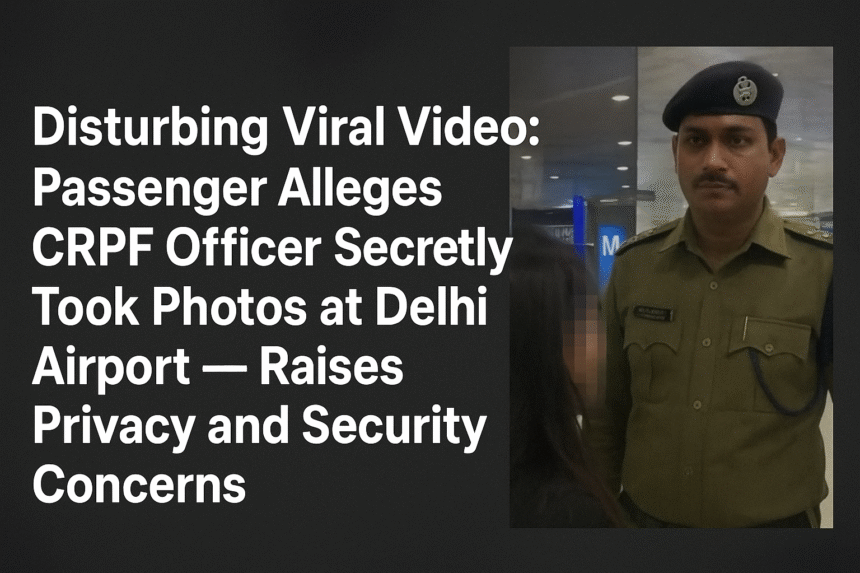
A disturbing incident has surfaced from Delhi’s Indira Gandhi International Airport, where a female passenger alleged that a Central Reserve Police Force (CRPF) officer secretly took her photographs without her consent. The claim went viral after she shared a video online, sparking outrage and debate about privacy, women’s safety, and accountability of security personnel.
This incident, now widely discussed across news portals and social media platforms, raises urgent questions: Are passengers’ privacy rights adequately protected at India’s busiest airports?
What Happened at Delhi Airport?
According to the passenger’s statement in her viral video, she was waiting near a boarding gate when she noticed the CRPF officer allegedly clicking her photos secretly. Shocked and uncomfortable, she confronted the officer and recorded a part of the interaction, which she later posted online.
The video quickly spread across platforms like X (formerly Twitter), Instagram, and WhatsApp, receiving thousands of shares. Several hashtags, including #AirportSafety and #WomenPrivacy, began trending.
CRPF’s Response
While official statements are still awaited from higher authorities, early reports suggest that CRPF headquarters has taken note of the viral video. Sources claim an internal inquiry may be launched to verify the facts, and disciplinary action could follow if the allegations are proven true.
Maintaining trust in security personnel is critical, as CRPF plays a frontline role in airport and national security. Any misconduct risks eroding public faith in law enforcement.
Public Reactions and Social Media Storm
The video has ignited a storm on social media. Many users expressed solidarity with the woman and demanded strict action against the officer. Others highlighted that this is not an isolated incident — several passengers in the past have raised concerns about being secretly photographed in public spaces.
Activists have linked the controversy to broader issues of women’s safety and digital privacy in India, urging the government to implement stricter guidelines.
Privacy and Legal Angle
Under Indian law, taking photographs of individuals without their consent in sensitive areas like airports can fall under violation of privacy and harassment statutes. If proven, the officer may face disciplinary proceedings and even legal consequences under:
- Indian Penal Code (IPC) Sections 354C (voyeurism)
- Information Technology Act (2000) – for misuse of digital media
Lawyers argue that airports are governed by both civil aviation rules and security protocols, making it essential that both passengers and officers are held accountable to clear standards of conduct.
Why This Matters – The Bigger Picture
This incident underscores the need for:
- Clear Guidelines for Security Forces – To prevent misuse of authority and maintain professional conduct.
- Passenger Awareness – Travelers should be aware of their rights regarding photography and harassment.
- Surveillance vs. Privacy Debate – With increased surveillance at airports, where does the line of personal privacy stand?
Such debates are vital in a country like India, where both national security and individual rights must coexist.
Internal Link (Context for Readers)
For more on recent controversies involving public safety and accountability, you can also read about the Karur Stampede Case and Vijay’s allegations against the state government. Both stories highlight the importance of public trust in governance and law enforcement.
External Links (Authoritative References)
- Learn more about the role of CRPF in India’s security on the Official CRPF Website.
- For detailed Indian laws on privacy and harassment, check Ministry of Law and Justice – Government of India.
- Coverage of the viral video on Times of India.
Conclusion
The viral allegation against a CRPF officer at Delhi airport has struck a chord nationwide, touching upon two of the most sensitive issues of modern India: privacy and women’s safety. As the inquiry progresses, the government’s response will be closely watched.
Whether this turns out to be a case of misconduct or misunderstanding, it serves as a reminder that in a democracy, security must never come at the cost of personal dignity and trust.