

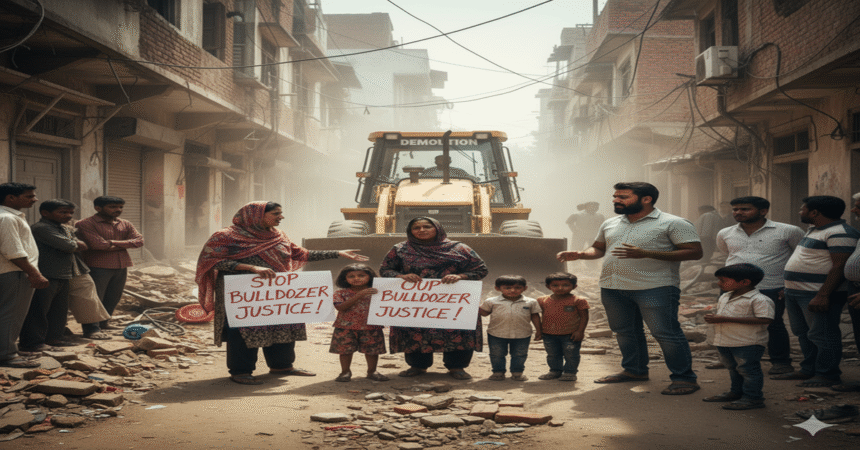
New Delhi, October 31 (News Desk):
The growing phenomenon of Bulldozer Justice in India has raised serious questions about human rights, fairness, and the rule of law. As Muslim families across several states face demolition of their homes, community leaders and legal experts are demanding accountability and transparency from the authorities.

Bulldozer Justice in India and the Rising Demolition Controversy
Bulldozer Justice in India has become a major political and social issue in 2025. Across Uttar Pradesh, Madhya Pradesh, and Gujarat, several homes belonging to Muslim families have been demolished under anti-encroachment drives, raising concerns of selective targeting.
Municipal teams, supported by police, have razed houses, shops, and schools — often without giving legal notice. Critics say this violates basic constitutional protections and represents the misuse of state power.
⚖️ H2: Supreme Court’s Response to Bulldozer Justice in India
The Supreme Court of India has strongly criticized the concept of Bulldozer Justice in India, stating that demolitions without due process are unconstitutional.
“No citizen should be deprived of property without due process of law,” said the Court.
Before any demolition, the court emphasized, authorities must issue written notices, allow response time, and provide access to appeal. Violating these steps transforms governance into retaliation — a direct threat to democracy.
🏠 H2: Muslim Families Share the Human Cost of Bulldozer Justice in India
Victims of Bulldozer Justice in India recount the emotional and financial trauma caused by sudden demolitions.
“We built our home brick by brick. In one afternoon, it was gone,” said Nusrat Begum from Ujjain.
Many families lost documents, belongings, and savings. Children were displaced from schools, and communities forced into temporary shelters. The sense of injustice has fueled protests across affected areas.
🏛️ H3: Government’s Defense and Global Reaction
Government officials argue that these are routine anti-encroachment drives, not acts of religious discrimination. However, Amnesty International and Human Rights Watch have condemned Bulldozer Justice in India as collective punishment targeting minorities.
👉 Read Amnesty International’s full report here (DoFollow link)
Meanwhile, Clarion India reported that over 8,500 Muslim homes were demolished in Ahmedabad, compared to negligible demolitions in Hindu-dominated areas — a clear sign of bias.
🔍 H2: Legal and Constitutional Challenges to Bulldozer Justice in India
Lawyers argue that Bulldozer Justice in India violates Articles 14 (Right to Equality) and 21 (Right to Life and Property).
The Supreme Court has proposed several safeguards:
- Mandatory video recording of demolitions
- Prior written notice to residents
- Legal aid for poor families
- Post-demolition rehabilitation
These steps, if enforced, could restore public trust and prevent future abuse.
🕊️ H2: Civil Society Calls to End Bulldozer Justice in India
Activists and civil groups urge the government to halt demolitions conducted under Bulldozer Justice in India and review each case for fairness.
“Justice must be equal for everyone,” said a Delhi-based lawyer. “When bulldozers replace the courts, democracy dies.”
The National Human Rights Commission (NHRC) has also taken suo motu cognizance of complaints related to such demolitions and issued notices to several state governments.
🌍 H2: The Bigger Picture — India’s Image and the Future of Democracy
The debate over Bulldozer Justice in India has reached the global stage. International media and rights organizations argue that selective demolitions tarnish India’s democratic image.
👉 Learn more from Human Rights Watch’s India report (DoFollow link)
Internally, political analysts warn that using bulldozers as symbols of power could deepen communal divides and weaken the rule of law.
🖼️ Suggested Image (with Focus Keyword in alt text):
- File Name: bulldozer-justice-in-india-demolition.jpg
- Alt Text: Bulldozer Justice in India demolishing Muslim homes during protests
🔗 Add Internal Links (examples):
(These internal links help search engines crawl your site better.)