
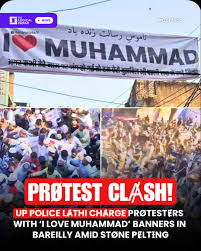
Bareilly, Uttar Pradesh — Tensions escalated sharply in Bareilly this past Friday when a protest in support of the “I Love Muhammad” campaign turned violent following Friday prayers. While the majority of supporters gathered peacefully to express their sentiments, clashes broke out between protestors and law enforcement officials, resulting in multiple arrests, injuries, and heightened security measures across the city.
What Sparked the Protest?
The protest was initially called Bareilly Protest by Maulana Tauqeer Raza Khan, head of the Ittehad-e-Millat Council (IMC), who announced a march aiming to submit a memorandum endorsing the “I Love Muhammad” campaign. However, local authorities denied permission for the demonstration, citing security concerns. Despite this, after Friday prayers, crowds carrying banners and slogans gathered in key locations, including the Kotwali area and near the cleric’s residence.
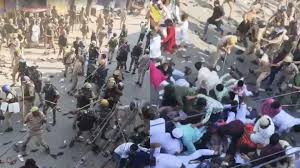
The Escalation: From Peaceful Gathering to Violence
Bareilly Protest As the protestors assembled, police attempted to disperse the crowd to maintain public order. According to eyewitnesses and police reports, a subset of demonstrators began throwing stones and damaging vehicles, escalating tensions significantly. Law enforcement responded with a baton charge, and several individuals were arrested on-site for their involvement in violent activities.
Over two dozen people were detained in the immediate aftermath, with FIRs filed on charges ranging from inciting religious hatred to attempted murder. The situation forced authorities to implement drastic security measures, including the shutdown of internet services in Bareilly to prevent the spread of misinformation and further unrest.
Legal Action and Government Response
In the days following the incident, the police intensified investigations, reviewing CCTV footage and mobile videos to identify suspects involved in the violence. Maulana Tauqeer Raza has been placed under house arrest, and his public speeches are now closely monitored by the government.
Uttar Pradesh Chief Minister Yogi Adityanath issued a stern warning to habitual lawbreakers, emphasizing that the state will take strict action to maintain law and order. Officials allege that the violence was part of a planned conspiracy, though they also highlight that most protesters (estimated at 90-95%) had prayed and dispersed peacefully.
Security Measures in Bareilly
To prevent further escalation, authorities deployed a heavy police presence across critical points in the city, including sensitive religious and commercial areas. The internet blackout, though disruptive, was deemed necessary by officials to curtail the rapid spread of inflammatory content on social media platforms.
This response has sparked debates on civil liberties, with some arguing that restricting internet access hinders communication and transparency, while others see it as essential for public safety.
Public Reactions: A Divided Community
Public opinion remains divided. Many community members and activists call for peaceful religious expression and dialogue, urging both authorities and protestors to avoid violence. Others stress the importance of maintaining strict law enforcement to ensure safety and prevent communal tensions from escalating.
The protest was initially called by Maulana Tauqeer Raza Khan, head of the Ittehad-e-Millat Council (IMC), who announced a march aiming to submit a memorandum endorsing the “I Love Muhammad” campaign. However, local authorities denied permission for the demonstration, citing security concerns. Despite this, after Friday prayers, crowds carrying banners and slogans gathered in key locations, including the Kotwali area and near the cleric’s residence.
For more background, see our detailed article on Religious Campaigns in India.
The incident has also raised concerns about social polarization and the delicate balance between freedom of expression and public order, especially in areas with diverse religious populations.
What Lies Ahead?
Local governance and law enforcement agencies in Bareilly now face intense pressure to restore normalcy and prevent similar incidents in the future. The event highlights the challenges governments face when managing large-scale religious protests, particularly those with potential for communal tensions.
Legal proceedings are ongoing, with the accused facing charges under national security laws. The broader implications of this unrest extend beyond Bareilly, raising important questions about religious freedom, political activism, and state response in Uttar Pradesh and across India.
Further Reading & References
- “I Love Muhammad row: 10 key points on Bareilly violence and cleric Tauqeer Raza’s detention” — Economic Times
- “Bareilly cleric among 8 held, 2,000 booked, 31 detained” — Times of India
- Local updates from Navbharat Times on internet shutdown and arrests
Government’s Approach to Managing Public Protests
Latest Updates on Uttar Pradesh Protests
Understanding Religious Campaigns in India