
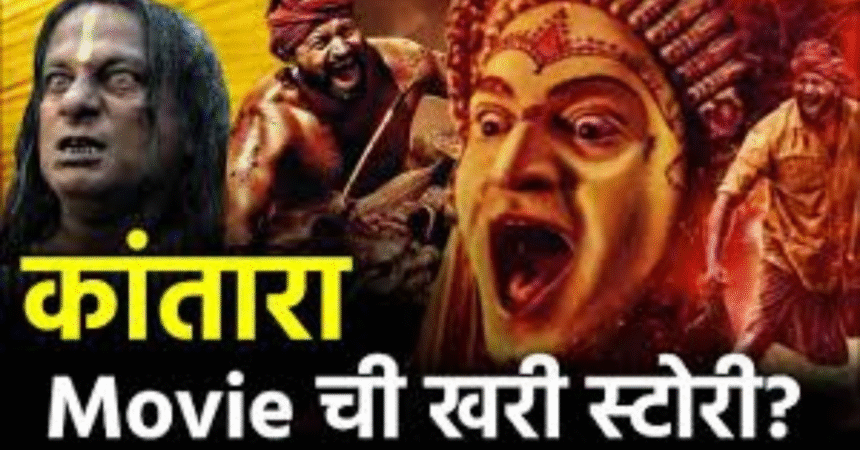
Kantara Chapter 1 launches the cinematic universe of Kantara into deeper mythological territory, promising to explore the ancient origins of its spiritual conflicts and deities. While the film is full of supernatural elements, rich folklore, and epic battles, it is built on cultural traditions and local practices from Karnataka’s coastal regions. The burning question is: how much of Kantara Chapter 1 is based on real traditions, and how much is myth-making?
In this article, we will:
- Give an overview of the film and its production
- Walk through the storyline (with major arcs)
- Investigate which parts are rooted in real folklore (Bhoota Kola, Panjurli, Guliga)
- Highlight the creative liberties and fictionalization
- Examine director Rishab Shetty’s inspirations and research
- Discuss the symbolic themes, cultural resonance, and controversies
- Conclude with a balanced understanding
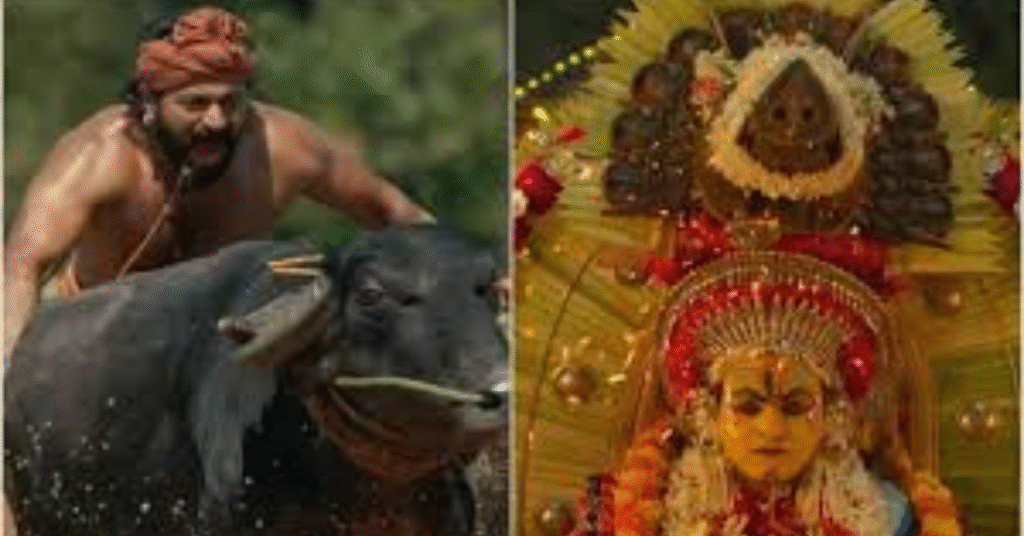
Table of Contents
- Film Overview & Production Details
- Storyline Summary of Kantara Chapter 1
- Cultural & Folk Traditions Depicted
- Fictional Elements & Creative Liberties
- Director’s Vision, Research & Inspirations
- Symbolism & Themes in the Narrative
- Cultural Impact, Controversies, and Discussions
- How to Watch with Cultural Sensitivity
- Conclusion
- FAQs
1. Film Overview & Production Details
Kantara Chapter 1 is a 2025 Indian Kannada-language epic mythological drama, written and directed by Rishab Shetty, and produced by Vijay Kiragandur and Chaluve Gowda under Hombale Films. Wikipedia+2The Federal+2
This film serves as a prequel to the original Kantara (2022), exploring the ancient roots of the lore introduced earlier. Wikipedia+1
Some key technical details:
- Runtime: ~169 minutes Wikipedia
- Language: Kannada (dubbed in other languages) Wikipedia+1
- Cast includes Rishab Shetty, Jayaram, Rukmini Vasanth, Gulshan Devaiah Wikipedia+2The Times of India+2
- Filming began in November 2023 in locations across coastal Karnataka, including Kundapura and forested areas. Wikipedia+2The Federal+2
The film has generated strong buzz: in a few days it crossed huge box office numbers in India. The Times of India+1
2. Storyline Summary of Kantara Chapter 1
Here’s a concise but comprehensive narrative of Kantara Chapter 1:
- The story is set in pre-colonial coastal Karnataka, during the era of the Kadamba dynasty. Wikipedia+2The Times of India+2
- King Vijayendra rules a territory near the forest of Kantara. He desires the sacred forest’s resources and sends agents to investigate. There is mythic tension around a spice garden and sacred forest. Wikipedia+2The Times of India+2
- His son Kulashekara becomes a tyrant, challenging the forest and tribal inhabitants. Wikipedia+1
- In the forest’s village domain, a boy emerges mysteriously at a sacred well and is adopted into the tribal fold. He is named Berme. Wikipedia+2The Federal+2
- Berme grows, interacts with Kanakavathi (daughter of royalty), and confronts the abuses of Kulashekara’s regime. Wikipedia+2The Federal+2
- Conflict escalates: soldiers attack the village, Berme’s foster mother is killed, spiritual possession events unfold, and supernatural guardians Panjurli and Guliga are invoked. Wikipedia+2The Federal+2
- Betrayals are revealed: Kanakavathi and her father had secret agendas linked with ritual power and the forest’s mysticism. Wikipedia+2The Federal+2
- Climactic confrontation sees Berme channel spiritual power (including transformation into a divine form akin to Ardhanarishvara), destroy conspirators, and restore peace. Wikipedia+2The Federal+2
- The film ends with Berme returning to the sacred well and disappearing, linking the legend to later events (and the timeline of the original Kantara). Wikipedia+1
The narrative weaves myth, spirituality and political power into a unified epic.
3. Cultural & Folk Traditions Depicted
One of the strengths of Kantara Chapter 1 is how it draws from real traditions — especially those of Tulu Nadu and coastal Karnataka.
Bhoota Kola / Daiva Worship
- The film heavily features Bhoota Kola, a ritual where local guardian spirits (daivas) are invoked, and performers “become” them during trance. Swarajya+4The Times of India+4Wikipedia+4
- Panjurli and Guliga — two spirits invoked in the film — are indeed part of regional folklore, especially in Tulu culture. The Times of India+2The Federal+2
- In actual Bhoota Kola practice, the rituals include storytelling (Paddana), invocation, drumming, possession state, and delivering socially relevant messages. Wikipedia+3Swarajya+3The Federal+3
Land, Forest & Tribal Conflict
- In many parts of coastal Karnataka, traditional communities have disputes over forest access, grazing rights, collection of minor forest produce, and land boundary conflicts. The film reflects these tensions in its conflict over who controls the forest. The Federal+1
- The idea of deified guardians protecting ancient forests echoes living beliefs: the forest is not just property but sacred, and breaking promises to guardian deities is spiritually dangerous.
Myth & Oral Tradition
- The film’s use of origin myth (king, divine stone, broken promise) is similar in spirit to oral folk narratives that communities pass down to explain land, nature, and morality.
- Use of ritual drama, festivals, and ceremonial conflict is consistent with how folklore helps communities preserve values and memory.
Thus, the film isn’t inventing the entire tradition — it is borrowing motifs, names, rituals, and belief frameworks that are real in the culture, then weaving its own mythology upon them.
4. Fictional Elements & Creative Liberties
To convert folklore into a cinema epic, Kantara Chapter 1 takes many creative liberties:
- Characters & Plot Lines: Berme, Kulashekara, Kanakavathi, and the exact conspiracies are narrative inventions. Their inner conflicts, dialogues, betrayals, and emotional arcs are cinematic constructs rather than historical fact.
- Divine Possession & Miracles: While Bhoota Kola rituals involve trance and spiritual states, the overt supernatural acts (spirits doing battle, transformations) are dramatized.
- Temporal Compression & Mythic Structure: The storytelling compresses centuries of tradition and conflict into a single narrative frame. It blends myth, history and speculative fiction.
- Divine Genealogies & Sacred Architecture: The narrative invents sacred wells, hidden chambers, divine relics and secret ritual spaces to heighten mystery.
- Plot Twist Betrayals & Ritual Power Politics: The betrayal of spiritual beliefs by royalty (e.g. Kanakavathi’s hidden agendas) is likely fictional, serving theme and dramatic tension.
These fictionalizations are not flaws — they are narrative devices that allow the film to explore cultural and spiritual questions in a dramatic way.
5. Director’s Vision, Research & Inspirations
Rishab Shetty has spoken in interviews about how Kantara Chapter 1 emerges from a desire to deepen the mythology first shown in Kantara (2022). The Times of India+1
Some known inspirations and processes:
- Shetty conducted field research in coastal Karnataka’s villages, studying Bhoota Kola practitioners, folklore, temple rituals, and local oral traditions.
- The film team reportedly sought permission from local communities and deity custodians (for example, Panjurli devotees) before filming in sacred sites. The Federal+1
- He stated that parts of the conflict between forest authorities and villagers in his home region shaped the conflict arcs. The Federal+1
- The film’s production involved large handcrafted sets, forest locations, costume design rooted in regional motifs, and action-choreography combining ritual movement with war sequences.
In interviews, Shetty revealed that on-shoot, he at times switched behind the camera into directing mode during intense sequences, balancing dual roles. The Times of India
Thus, even though the story is mythic, its roots and creative impulse are grounded in local history, belief and landscape.
6. Symbolism & Themes in the Narrative
Kantara Chapter 1 works on multiple symbolic levels. Key themes include:
- Nature as Sacred, Not Commodity: The forest and land are not resources to exploit but entities to protect.
- Broken Promises & Oath: Central to the original lore is that breaking a promise to deities triggers cosmic consequence.
- Power & Corruption: Royalty, greed and spiritual manipulation reflect how authority can betray moral roots.
- Faith vs Doubt: Characters struggle with belief, spiritual legitimacy, and the tension between tradition and rational order.
- Identity & Belonging: Berme’s mysterious birth, tribal roots, and role as medium reflect on identity and spiritual inheritance.
- Divine Juxtaposed with Mortal: The film frequently blurs the human and divine, asking how humans mirror gods or betray them.
These themes resonate beyond regional culture and speak to universal questions about how traditions survive, how power is checked, and how meaning is constructed.
7. Cultural Impact, Controversies, and Discussions
Since its release, Kantara Chapter 1 has generated strong response:
- The film crossed huge box office milestones in India within days of its release. The Times of India+1
- Prominent actors like Jayaram gave strong reviews for the mythology and narrative. The Times of India
- However, some critics pointed out concerns:
- Appropriation debate: Some argue that Bhoota Kola is an indigenous practice, not originally part of mainstream Hindu tradition, and the film risks blending or subsuming it. The Federal+1
- Myth as propaganda: Others feel the film simplifies complex folk traditions into a binary spiritual good vs evil narrative.
- Safety & production controversies: During filming of Kantara: Chapter 1, a junior artist drowned in an incident, leading to FIRs and debate about on-set safety. This tragic event underlines the real-life stakes in such ambitious projects. The Economic Times+1
These dialogues show that a film of this scale becomes a cultural event with real-world ripples.
8. How to Watch with Cultural Sensitivity
When watching Kantara Chapter 1:
- Recognize it as a mythologized narrative, not a documentary.
- Respect the traditions represented — they have deep cultural significance in certain communities.
- Use it as a prompt to learn the real practices (for example, read about Bhoota Kola via anthropology sources).
- Avoid literal equivalence (i.e. saying “this is exactly what happened”) — enjoy the imagination.
- Appreciate how cinema can bring regional culture to a national audience while also inviting scrutiny and dialogue.
9. Conclusion
Kantara Chapter 1 is a powerful blend of imagination and tradition. It draws from real folklore, ritual practices, and land conflict present in coastal Karnataka, then builds upon them a mythic saga of divine struggle, betrayal and renewal. The film is neither fully historical nor entirely fantasy — it resides in a creative space that amplifies spiritual and cultural resonance while entertaining.
Its success shows how rooted stories, when told with artistry, can transcend region and language. But it also reminds us that with power comes responsibility — to portray cultural traditions sensitively and to invite discussion rather than dictate belief.
FAQs
Q1: What is Kantara Chapter 1 about?
Kantara Chapter 1 is a mythological prequel that explores the origins of deities, forest conflicts and spiritual lore in pre-colonial Karnataka.
Q2: Is the story of Kantara Chapter 1 based on real events?
No — it is fictional but inspired by real folklore traditions such as Bhoota Kola, tribal legends, and land disputes in coastal Karnataka.
Q3: Who directed Kantara Chapter 1, and what motivated the film?
Rishab Shetty directed and starred in it. He was inspired by local folklore, his region’s traditions, and the success of the first Kantara.
Q4: What folk rituals are depicted in the film?
The film features Bhoota Kola rituals, invocation of deities like Panjurli and Guliga, trance possession, and ritual drama rooted in Tulu Nadu culture.
Q5: Has Kantara Chapter 1 faced any controversies?
Yes. There are debates about cultural appropriation, safety incidents during production, and conversations on how the film depicts indigenous practices.