

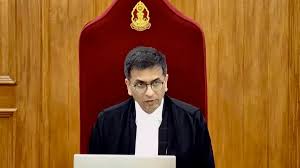
New Delhi, September 25, 2025 — Former Chief Justice of India DY Chandrachud has triggered a fresh debate over the Ram Mandir Supreme Court Verdict with his recent remarks. Chandrachud stated that “the very erection of the Babri Masjid was a fundamental act of desecration”, a claim that many legal experts argue is not in line with the 2019 Ayodhya judgment
What Did DY Chandrachud Say?
In an interview with journalist Sreenivasan Jain, published on Newslaundry, Chandrachud defended the Ayodhya verdict, arguing that historical evidence could not be ignored. He claimed:
“When you said that it was the Hindus who were desecrating the inner courtyard, what about the fundamental act of desecration — the very erection of the mosque? We forget all that happened in history.”
He also pointed to archaeological excavations by the ASI, which indicated the presence of a Hindu religious structure beneath the mosque. According to him, critics of the verdict have taken a “selective view of history.” (Read full coverage on LiveLaw)
What Did the 2019 Supreme Court Judgment Say?
The five-judge Constitution Bench, which included Chandrachud himself, had unanimously ruled in favor of the Ram Mandir construction in Ayodhya. However, the judgment clearly noted:
- The ASI report suggested a non-Islamic structure beneath the Babri Masjid, but it did not prove demolition of a temple to construct the mosque.
- There was a 400-year gap between the earlier structure and the mosque’s construction, making direct causation impossible.
- The Court awarded the disputed land to Ram Lalla Virajman while directing that 5 acres of land be allotted to the Sunni Waqf Board for building a mosque.
📌 Internal link suggestion: For detailed coverage of the case history, see our Law & Judiciary section.
Criticism and Reactions
Chandrachud’s latest remarks have sparked sharp criticism:
- Legal scholars argue that his comment appears inconsistent with the judgment text.
- Human rights activist Suchitra Vijayan said his language mirrors political narratives rather than legal reasoning.
- Journalists like Sreenivasan Jain pointed out that the Court itself had admitted “no evidence of demolition”.
Meanwhile, supporters argue that Chandrachud was only highlighting the historical context and not contradicting the legal reasoning.
📌 Internal link suggestion: Check our Politics section for updates on how political parties are reacting.
Political Context
The Ram Mandir verdict has been a major ideological victory for the BJP and RSS. Prime Minister Narendra Modi inaugurated the temple in 2024, calling it a symbol of “restored faith and justice.”
However, the mosque that was supposed to be built on the allotted 5 acres in Dhannipur village has yet to take shape. According to RTI reports, delays in permissions and clearances have slowed progress. (The Hindu report)
Why This Matters
- Judicial credibility: If a judge publicly departs from the written verdict, it raises doubts about judicial consistency.
- Historical vs legal reasoning: The line between archaeological evidence and legal proof becomes blurred.
- Public trust: The perception that verdicts are influenced by ideology, not evidence, could weaken confidence in the judiciary.
📌 Internal link suggestion: Read our Opinion piece on how such controversies impact India’s secular framework.
Conclusion
The Ram Mandir verdict remains one of India’s most consequential court decisions. With Chandrachud’s latest comments, questions resurface: was the judgment based purely on law and evidence, or did it lean toward faith and politics?
As debates continue, the legacy of the Ayodhya case is once again at the center of India’s political and judicial discourse.
The Ram Mandir verdict has been a major ideological victory for the BJP and RSS. Prime Minister Narendra Modi inaugurated the temple in 2024, calling it a symbol of “restored faith and justice.”
However, the mosque that was supposed to be built on the allotted 5 acres in Dhannipur village has yet to take shape. According to RTI reports, delays in permissions and clearances have slowed progress. (The Hindu report)