


The path of human progress is paved with scientific discoveries that fundamentally rewired our understanding of the universe. These aren’t just incremental additions to knowledge; they are paradigm shifts that launched new eras, ended old ones, and gave humanity new powers. Let’s delve into the ten most revolutionary scientific discoveries that forever altered our trajectory.
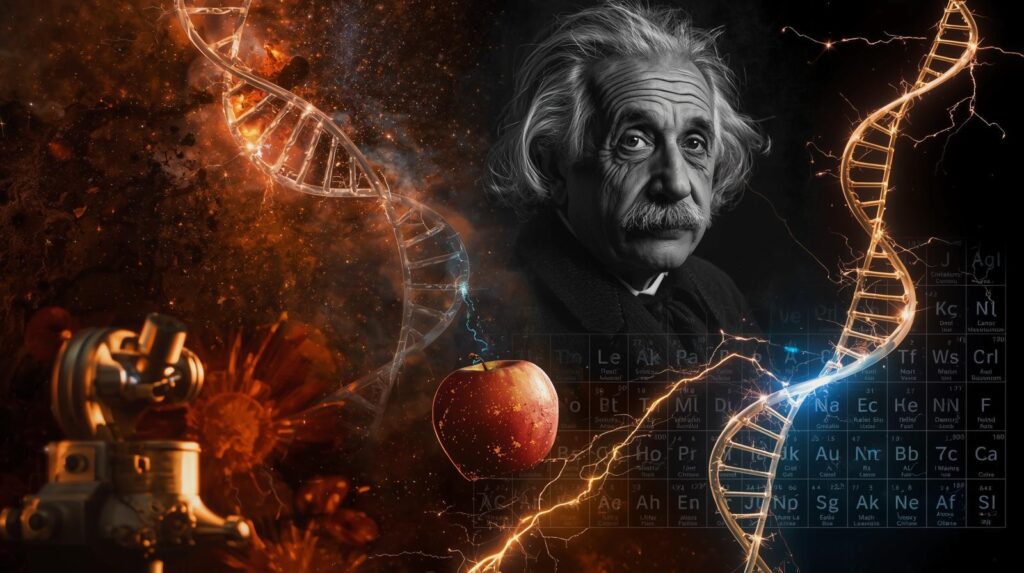
1. Germ Theory: The Medical Revolution
For centuries, the cause of disease was a terrifying mystery. The groundbreaking work on Germ Theory by pioneers like Louis Pasteur and Robert Koch revealed that invisible microorganisms were the true culprits. This single insight became the cornerstone of modern medicine, leading to antiseptic surgery, antibiotics, vaccines, and sanitation systems that have saved countless lives. It is, without doubt, one of the most impactful scientific discoveries in history.Scientific Discoveries is revolution for science
2. DNA’s Double Helix: Decoding the Blueprint of Life
The 1953 revelation of DNA’s structure by Watson, Crick, and Franklin was a monumental leap. Understanding this elegant double helix provided the mechanism for heredity itself. This breakthrough ignited the fields of genetics and molecular biology, paving the way for genetic engineering, medical diagnostics, and cutting-edge treatments like CRISPR. As the National Human Genome Research Institute details, it was the key that unlocked the code of life.
3. Harnessing Electricity: Powering the Modern Age
The discovery of how to generate and utilize electrical energy, largely thanks to Michael Faraday’s work on electromagnetism, lit the spark for the modern world. This breakthrough transformed every aspect of life, from ending the darkness with electric light to powering industries and enabling the digital revolution. It is the invisible force that powers our civilization.
4. Penicillin: The Accidental Miracle
Alexander Fleming’s 1928 discovery of penicillin was a fortuitous accident that changed medicine forever. This first antibiotic turned previously fatal bacterial infections into treatable conditions, creating a new arsenal in the fight against disease and dramatically increasing human life expectancy.
5. Newton’s Laws of Motion and Universal Gravitation
Isaac Newton’s Principia Mathematica did more than explain gravity; it provided a universal mathematical framework for predicting the motion of objects on Earth and the heavens above. This foundational work made engineering, physics, and eventually spaceflight possible, establishing the very principles of classical mechanics.
6. Evolution by Natural Selection: Biology’s Unifying Theory
Charles Darwin’s theory of evolution provided a powerful, elegant explanation for the diversity of life. It argued that complex organisms evolve from simpler forms through adaptation and natural selection. This concept became the central, unifying pillar that connects all biological science, as explained by resources like Britannica.
7. Quantum Mechanics: The Rulebook for the Subatomic World
Venturing into the atomic realm, physicists found a world that defied intuition. Quantum mechanics, developed by figures like Planck and Bohr, revealed the bizarre rules governing particles. This wasn’t just theoretical; it provided the principles behind transistors, lasers, and semiconductors—the bedrock of all modern technology.
8. Einstein’s Theory of General Relativity
Einstein proposed that gravity is not a force but a warp in the fabric of spacetime itself. This theory of General Relativity accurately predicted black holes, the bending of light, and is essential for the accuracy of modern GPS systems. It redefined our understanding of the cosmos on the grandest scale.
9. The Periodic Table: Chemistry’s Organizational Masterpiece
Dmitri Mendeleev’s Periodic Table did more than list elements; it predicted them. By organizing elements by atomic weight and properties, he left gaps for undiscovered elements, whose properties he accurately foretold. This table remains the essential map for all chemical research and innovation.
10. The Invention of the Internet
What began as a project (ARPANET) to create a resilient communication network evolved into the global digital nervous system we know today. The internet is a meta-discovery—a breakthrough in connectivity that has transformed every facet of modern life, from communication and commerce to education and entertainment.
Conclusion
These scientific discoveries represent more than facts; they are seismic shifts in human thought and capability. Each one started with a question and grew into a beacon that illuminated a new path forward, proving that our quest to understand the universe is humanity’s ultimate engine of progress.